Subterranean termite barrier treatments establish an uninterrupted chemical defense band around concrete slabs, raised foundations, and utility entry points. In Western subterranean termite biology, workers travel…
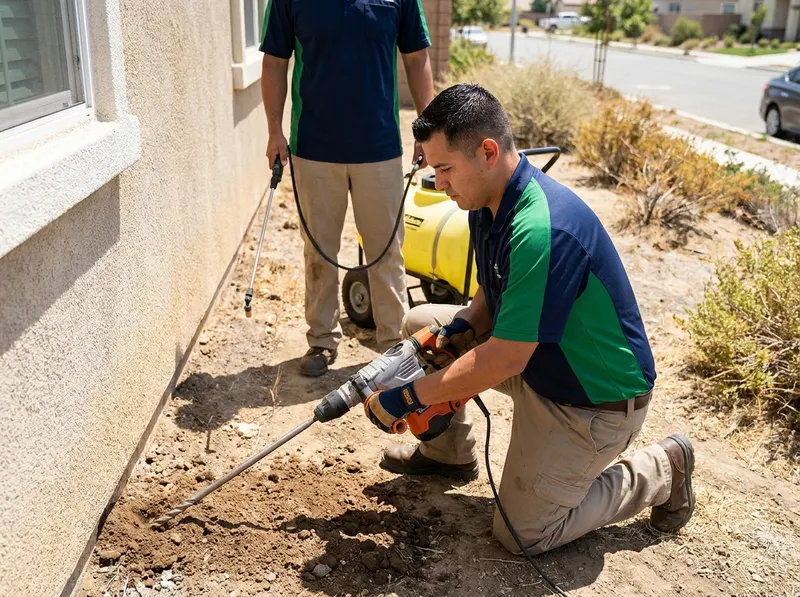
Subterranean termite barrier treatments establish an uninterrupted chemical defense band around concrete slabs, raised foundations, and utility entry points. In Western subterranean termite biology, workers travel upward through subterranean soil layers seeking structural cellulose. Trenching along foundation perimeters measures approximately 6 inches wide by 6 inches deep, allowing direct liquid saturation into the backfill soil at a standard rate of 4 gallons per 10 linear feet per foot of depth, in accordance with EPA pesticide regulations and strict label parameters enforced by the California Department of Pesticide Regulation. For concrete-abutted structures like patios, carports, and walkways, technicians perform precision horizontal drilling spaced roughly 12 inches apart to deliver termiticide underneath flatwork before sealing holes with specialized hydraulic cement patches matching building codes monitored by the California Building Standards Commission.
Soil types across Riverside dictate specific application techniques. Properties situated on decomposed granite and sandy loam around Canyon Crest, Hawarden Hills, and Orangecrest allow rapid termiticide dispersion but require calibrated pressure settings to avoid premature runoff toward landscape features. In contrast, heavy alluvial clay soils prevalent near Victoria, Arlington Heights, and citrus acreage along California Citrus State Historic Park demand rodding techniques with extended soil dwell times to saturate dense clay aggregates. Western subterranean termites enter structures through foundation hairline cracks as narrow as 1/32 of an inch, making the liquid barrier approach superior to structural spot foams for whole-perimeter defense. Homeowners can verify contractor registration through the Structural Pest Control Board before starting work.
Choosing between perimeter liquid barrier treatments and localized exterior bait systems comes down to soil disturbance tolerance versus structural speed. A liquid barrier treatment binds to substrate particles immediately, neutralizing termites within 30 to 90 days as foraging workers transport termiticide particles through social grooming back to subterranean nests. Baiting systems involve plastic ground stations monitored over 6 to 12 months, which avoids concrete drilling around decorative stone entries in historic neighborhoods like Downtown Riverside and the Wood Streets, but baiting prolongs active foraging during structural settlement. Riverside soils along the Santa Ana River basin maintain underground moisture reservoirs documented by the Santa Ana Regional Water Quality Control Board, accelerating subterranean colony sizes near low-lying foundations in La Sierra and Magnolia Center.
ShieldPoint Exterminators executes precision perimeter barrier defense to protect foundation integrity. Structural inspections evaluate crawlspace framing clearances guided by standard wood decay metrics from the USDA Forest Products Laboratory, while exterior landscape borders are checked for drip line drainage issues tracked by the Riverside County Flood Control and Water Conservation District. Surface mulch depth, wood-to-earth contacts, and plumbing penetrations are documented according to termite defense procedures published by UC Statewide IPM Program and educational research from the Department of Entomology at UC Riverside. Structural measurements confirm linear footage to generate a firm on-site quote. Property owners can schedule a physical foundation assessment or report active mud tube discoveries by calling (951) 208-7150.
Every job gets a firm, written price after a free on-site visit.
For standards, safe disposal, and service guidance on PEST CONTROL SEVICE in Riverside, CA, useful references include U.S. EPA, ENERGY STAR, U.S. Dept. of Energy, Consumer.gov, U.S. Census Bureau, and Google Maps. General consumer and small-business resources are available from USA.gov, Better Business Bureau, FTC Consumer Advice, U.S. Small Business Administration, and Ready.gov.
Tell us about your subterranean termite barrier treatment job in Riverside and we'll send a clear, written quote, usually the same day.
 ShieldPoint Exterminators