Structural rodent exclusion operates on the architectural principle of mechanical defense rather than passive, repeated chemical baiting. A standard roof rat ( California Department of Public Health vector guidelines…
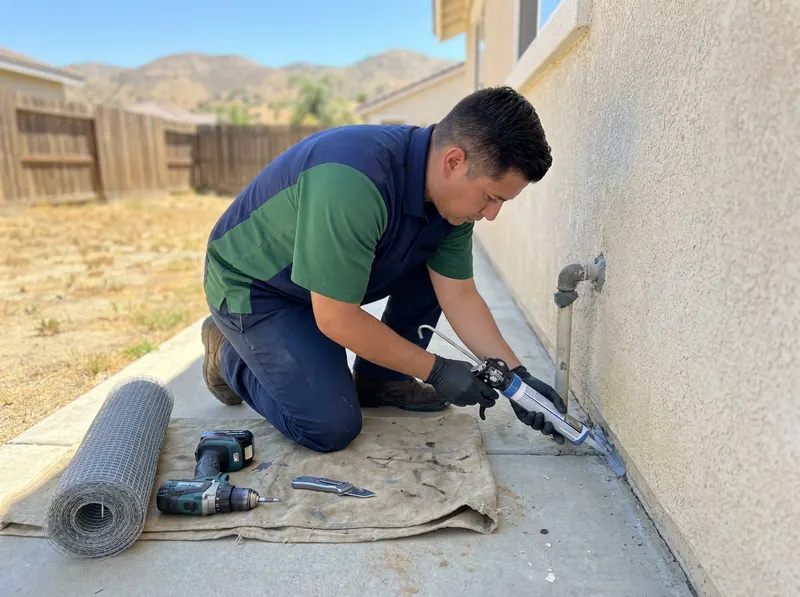
Structural rodent exclusion operates on the architectural principle of mechanical defense rather than passive, repeated chemical baiting. A standard roof rat (California Department of Public Health vector guidelines note their agility) requires an opening of only 0.5 inches to enter an attic, while house mice can squeeze through a gap measuring 0.25 inches. In historic properties across Downtown Riverside and the 1920s craftsman homes of the Wood Streets, foundation crawlspace vents and dry-rotted fascia boards provide continuous access routes. ShieldPoint Exterminators secures these envelope vulnerabilities directly using welded 19-gauge ASTM A740 galvanized hardware cloth and elastomeric polyurethane sealants rated to withstand the 105°F summer heat typical of the Santa Ana River basin. This mechanical barrier prevents entry without requiring homeowners to sign multi-year re-treatment contracts, addressing the primary architectural failure points permanently.
Properties in foothill and citrus-adjacent regions like Orangecrest, Mission Grove, and Hawarden Hills face persistent pressure from citrus rats foraging around lemon and orange groves, while suburban developments in Canyon Crest, Magnolia Center, and Arlington Heights frequently experience roof-line penetrations along tile roof transitions. Tree squirrels and Norway rats travel utility lines leading from secondary poles to house eaves, chewing directly into unsealed attic vents. The standard protocol adheres to strict containment measures outlined by the CDC structural rodent guidelines, outfitting roof transitions with custom-bent sheet metal flashing, sealing AC line chase units with copper mesh and non-shrink hydraulic mortar, and securing weep screeds with specialized foundation barrier grates. Unlike basic expandable spray foam, which rodents easily chew through within 48 hours, these high-tensile physical materials cannot be compromised by gnawing incisors.
Environmental variables across Victoria and La Sierra necessitate focused moisture auditing alongside entry sealing. Rodents exploit sub-slab moisture beneath older plumbing manifolds and HVAC condensation lines. Structural exclusion eliminates access to indoor water points while establishing physical barriers across crawlspaces and garage sill plates. Adherence to safety standards published by the EPA Integrated Pest Management program ensures exclusion occurs in tandem with tactical interior trapping to capture any pests trapped inside the envelope during physical installation. Structural repair work coordinates alongside established construction and electrical envelope protocols defined by the International Code Council, the NFPA 70 National Electrical Code for cable chases, the National Pest Management Association exclusion best practices, structural standards from the American Society of Civil Engineers, and vector boundary regulations through the Riverside County Department of Environmental Health. Structural exclusion eliminates ongoing toxic chemical placements, creating a child- and pet-safe perimeter defense without continuous poison exposure on residential turf.
Every job gets a firm, written price after a free on-site visit.
For standards, safe disposal, and service guidance on PEST CONTROL SEVICE in Riverside, CA, useful references include U.S. EPA, ENERGY STAR, U.S. Dept. of Energy, Consumer.gov, U.S. Census Bureau, and Google Maps. General consumer and small-business resources are available from USA.gov, Better Business Bureau, FTC Consumer Advice, U.S. Small Business Administration, and Ready.gov.
Tell us about your structural rodent exclusion and entry sealing job in Riverside and we'll send a clear, written quote, usually the same day.
 ShieldPoint Exterminators